Does Avast For Mac Keep My Mac Safe
- Does Avast For Mac Keep My Mac Safe From Viruses
- Does Avast For Mac Keep My Mac Safe Mode
- How Do I Keep My Mac Safe
- Does Avast For Mac Keep My Mac Safe
Today's best Avast Free Mac Security deals
- Avast Free Antivirus for Mac is a free antivirus program with a virus scanner, firewall, and various features that you can turn off or on. The program is free, but will request payment for some features, which means that you can’t expect everything in the features section to be free.
- Even though Mac computers have a slimmer chance at having a computer virus, it is a smart move to download some kind of antivirus for Mac program to have in order to keep your computer safe. With a comprehensive Avast for Mac review, you can get all the facts you need in order to fully protect your computer and all of your important personal files.
- Learn about the built-in Mac security software you already have, as well as other helpful tips and tools to keep you safe online from viruses, ransomware, and other cyberthreats. Macs are beautiful machines, in both appearance and performance. The sleek designs, intuitive OS, trend-setting apps,.
- It won't quit, and I can do a backup with an open application. - Answered by a verified Mac Support Specialist We use cookies to give you the best possible experience on our website.
Avast is actually one of those options, and in my opinion, it’s quite good at doing the job of keeping your PC or Laptop safe from viruses. The thing I am afraid of is someone hacking my webcam. With that being said new Avast 2018 comes with handy feature named Webcam Shield.
Avast Free Mac Security doesn't break a lot of new ground. As is the case with most free software, it does an OK job and — like popular free-to-play games — aims to pull money from your pockets after it's installed.
The one major perk of Avast Free Mac Security is that it can identify attacks in your email inbox, a feature that we'd like to see in all Mac antivirus services. At the end of the day, though, Avast's Mac malware protection rate isn't quite as good as its competitors', which is the most important part of antivirus software.
Avast Free Mac Security costs and what's covered
Avast Free Mac Security is free. It supports Macs running any version of macOS, as long as they have 128MB of RAM and 750MB of available disk space.
Antivirus protection
Avast Free Mac Security keeps Macs free of malware using traditional signature-based detection by unpacking Mac-specific file formats and scanning them for malicious content. It also uses its artificial-intelligence system to apply lessons from its user base to train its software.
Avast also thwarts PC malware on Mac, to prevent it from spreading on networks, and scans unopened ZIP files. It performs system protection scanning in the background, permits both on-demand and scheduled scans, and can scan your router to protect you against DNS hijacking and other threats.
Antivirus detection
Avast Free Mac Security's on-demand malware-scanning engine has a mixed record in recent lab tests. It stopped 100% of malware in tests conducted by Austrian lab AV-Comparatives in July 2018 and June 2019.
Results from German lab AV-Test were less consistent: 100% of Mac malware was detected by Avast in June 2018 and June 2019, but Avast caught only 96.3% of malware in December 2018.
That means Avast tied with Bitdefender Antivirus for Mac and Kaspersky Internet Security for Mac on the AV-Comparatives test (both hit 100%). However, it failed to match Bitdefender, Kaspersky and Norton 360 Deluxe on the AV-Test study, in which all three earned 100% scores.
Of all the Mac antivirus programs we tested, Avast Free Mac Security was the only one that flagged items already on our system as threats. Specifically, it found three email messages in my old, inactive, Outlook database that contained links to phishing websites.
Security and privacy features
Avast Free Mac Security includes Avast's Online Security browser extension, which automatically installs itself in Chrome unless you opt out, while Firefox provides a confirmation prompt to make sure you approve the extension. The Avast extension appears as a button that is green when you're safe and red if a site is potentially harmful. Similar flags will appear next to search results.
If you're wary of sites that monitor your actions, the Avast browser extension also displays a counter badge that tallies the number of activity trackers found in a website and provides an additional option to block social network-based tracking.
Not only does Avast scan activity on your hard drive and web browsers, but it also monitors POP3 and IMAP email clients, including Apple Mail, Thunderbird, Postbox and Airmail, and scans email attachments as well as email messages.
Avast monitors your computer and its network connections in the background, scans new files upon installation and lets you schedule scans. However, Avast Free Mac Security doesn't have any of the extra features offered by paid competitors, such as parental controls, a VPN service, firewalls or webcam blockers.
Performance and system impact
Avast Free Mac Security had a moderate impact on system performance, which we assessed by running our custom Excel VLOOKUP benchmark test, which matches 60,000 names and addresses on a spreadsheet. Our test machine wasa 2017 MacBook Air with a 1.8-GHz Intel Core i5 CPU and approximately 54GB of data stored on a 128GB SSD.
With Avast Free Mac Security installed on our MacBook, but without any active scans running, the VLOOKUP test finished in an average of 3 minutes and 38 seconds, 1 second longer than without any antivirus software installed. That's a passive system hit of less than 1%, and not something you would likely perceive.
Avast Free Mac Security is the most downloaded antivirus for Mac with more than 4.5 million downloads Also, the user reviews on Download.com are very positive. Avast Free Mac Security 2018 has 4.5 stars (out of 5) from 1,641users. Best free antivirus for Mac: Avast Free Mac Security Many antivirus suites provide a decent level of protection, but a few rise above all others by providing the very best in performance. Avast Security is a free antivirus that stops malware & finds Wi-Fi security weaknesses. Free Download! In order to view this page correctly, you must have a JavaScript-enabled browser and have JavaScript turned on. Is avast free antivirus good for mac.
MORE: Hackers Say They've Breached Three Antivirus Companies
Other antivirus products' passive system impacts ranged from 5% (Sophos Home Premium) to zero percent (Bitdefender). This is overall great news for Mac users: Most of the time, you'll never notice that you've got antivirus software running.
You would be more likely to notice the slowdowns created by Avast's active scans. During full-system scans, the VLOOKUP test finished in an average of 4 minutes and 59 seconds, resulting in a big performance dip of 37 percent. That's not as bad as McAfee AntiVirus Plus' 47% fall (the worst offender), although it wasn't as good as Sophos' 7% full-scan system hit.
Avast's full-scan completion time, which took an hour and 11 minutes on average, was on the longer end of scores but was not the longest we found — Sophos' 2-hour-and-56-minute time was the longest. Malwarebytes for Mac Premium's full scan took a miraculous 16 seconds, while Bitdefender closed its full scan in 4:25. Kaspersky (41:20) and Norton (25:49) fell in the middle of the pack.
Interface
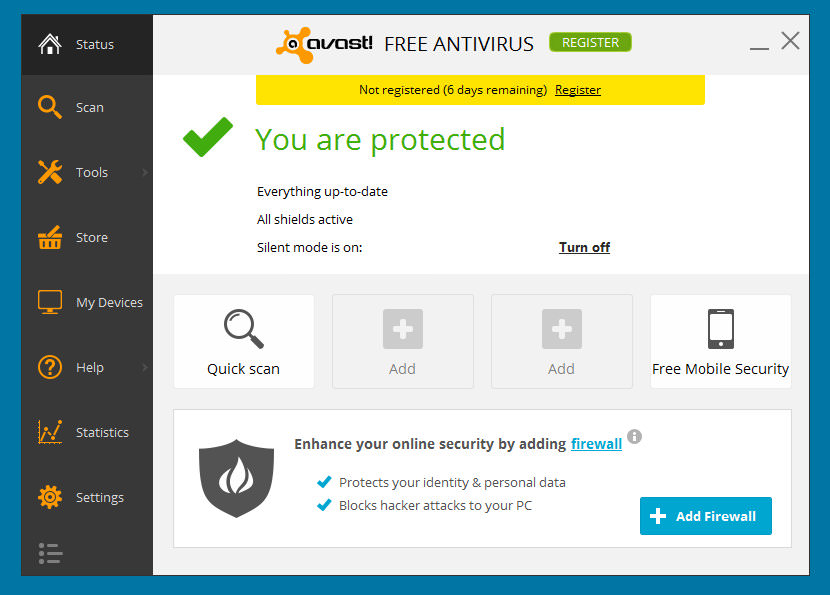
Avast Free Mac Security may not be the prettiest antivirus app, but it provides a number of functions and options. Its main window shows users a Protected status, as scans are enabled by default. All other features, including on-demand scans, are located in a menu bar on the left.
Avast's main window presents users with their status — Protected or otherwise — and a 'Run scan' button that pushes you to Avast Cleanup Pro. You'll be confused by this abrupt switch of apps if you weren't paying attention to the fine print, and you'll soon realize that Cleanup Pro is a paid product that looks to tidy up your hard drive and costs between $2.99 or $3.99 per month.
MORE: Best Free Antivirus Software
After you click that Run scan button once, it changes to an Upgrade button for Avast Security Pro, which features anti-ransomware protections and Wi-Fi and network scanning. To avoid further confusion, click on Scans in the left-hand menu, which opens that section as well as other sections of the app, such as Reports, Virus Chest, Shields and Preferences.
In Scan, you can select from a number of different types, such as scans of custom directories, scans of removable volumes and scans of your home network. Avast also includes scheduled scans, an increasingly rare option these days.
Clicking on New Scan presents a Start button for activating a Quick Scan and a Change Scan Type button to switch to a full-computer scan.
You'll find database updates and analyses of scans performed on your system in Avast's Reports. Avast places files it flags as malicious into the Virus Chest quarantine section, where you can delete or restore them (if you think Avast is mistaken).
Open the Shields section to see real-time analysis of scanned files. Annoyingly, if the file directory is especially long, Avast won't give you the full directory, so you can't go look up the offending file for yourself. You may not need to, but we'd prefer to have the option.
In the Preferences tab, you'll find options to change the frequency of notifications, system updates and scans. Here, you can also disable hard-drive, email and web protection, although Avast wisely makes you enter your system password first. Additionally, you can disable Avast's menu-bar icon from this window (it's under Miscellaneous).
If you create an account with Avast, you can check the status of any systems you've logged into in the Account tab as well as at my.avast.com. Avast's menu-bar button provides links to open the main interface window, see current activity and application information, and review previous notifications.
Installation and support
To install Avast Free Mac Security, you open Avast.com and click Download, which will place the installer DMG on your Mac. (Thankfully, you won't have to go through download.com anymore, an annoying part of the previous model.) After you click through the end-user-license agreements, the installer will download more files and install Avast.
No restart is required, and the whole process took about 2 minutes for me, which felt about normal. In the middle of the installation, you get the option to not install Avast's unlimited Password Manager and the company'sSecureLine VPN client. The Avast Online Security browser plug-in is free, but you get only a seven-day trial of SecureLine VPN service, which otherwise starts at $60 per year.
To get technical support, click Help in the menu bar, select Avast Technical Support and then select Contact Help to open Avast's Support site. Here, you can find a FAQ, ask for help in the forums and call a customer-support line that will provide free advice for installing, configuring, updating and removing Avast.
MORE: How to Buy Antivirus Software
If you need more help than that, Avast offers paid support starting at $79 for any call that isn't related to removing a virus or malware, or at $119 per call for virus-related calls. For more support, you can spend $199 for a year of unlimited service, or $10 per month plus a $99 setup fee.
Bottom line
Avast's email scanning gives it an edge over competing Mac antivirus products. It needs such an advantage when the rest of its package is such a mixed bag.
Not only does Avast's software continually push you to spend money on additional services (unlikely if you've already chosen to use free antivirus software), but its malware detection rates aren't great overall.
If you're going to pay, you should instead choose Bitdefender Antivirus for Mac, which gives you excellent protection and a low system impact for $40 a year. If
you'd rather not pay, then Avast is the best free option, but only because Sophos Home, which has a more full-featured free tier, has undetermined malware-protection abilities on Macs.
I know that anyone can access my computer whenever I’m not looking, so I’ll try to prevent others from getting at my private data.
Use admin accounts for administration only
Security: 2 Hassle: 1
When you initially set up your Mac, OS X creates a single user account for you. That account includes administrative rights, which give you the authority to install, change, or delete anything on the computer.
Using that administrator account as your normal, day-to-day login account can be risky. First, you make it easier to mistakenly change or delete something crucial to your computer’s operation. And second, you open a potential security hole: if you step away from your computer without logging out, someone else will have complete access to your Mac’s data and settings. So the safest course is to set up a second user account, without administrative privileges, and use that as your main day-to-day account. When you need to install software or perform some other administrative tasks, you can still log in to the administrator account.
To set up a new nonadministrator account, open the Accounts pane of System Preferences. If the lock icon in the bottom left corner is closed, click on it and enter your administrator password. Then click on the plus (+) icon to create a new account. You can use the same first and last name as in your existing account, but you must choose a different Short Name. Enter and verify a password, but do not select Allow User To Administer This Computer. Then click on Create Account. If you want to transfer any data (such as preferences files or e-mail messages) from your current account to the new one, drag the items from their current location in your Home folder to the corresponding location in the new account’s Home folder.
| KEY Security 4. Makes you practically invulnerable. 3. Good, strong protection—but a really determined intruder can overcome it. 2. Helps deter casual meddlers, but someone who wants to get in will. 1. Makes you feel better, but won’t really keep out intruders. Hassle 4. Let’s be honest: it’s a pain in the neck. 3. Takes consistent, considerable effort. 2. Takes a little effort, but it’s not a big problem. 1. Set it and forget it. |
Now, choose Log Out user name from the Apple menu and log back in as the new, nonadministrative user. From now on, use your standard account except when you have a specific reason not to.
Don’t share user accounts
Security: 2 Hassle: 2
If more than one person uses your computer, make sure each user has a separate account. Doing so keeps mail, documents, keychains, browser history, and other personal data safe from casual snooping.
To add an account on your Mac, open the Accounts pane in System Preferences. If the lock icon at the bottom of the pane is closed, click on it. When the Authenticate dialog box appears, enter your administrator password. Then click on the plus (+) button right above the lock, enter long and short user names and a password for the new user, and click on Create Account. Do not select the Allow User To Administer This Computer option.
Once your accounts are set up, be sure to use them. Whenever you finish working on your computer, choose Log Out user name from the Apple menu. The computer will then display the login screen, where the next user can enter a user name and password to log in.
Turn on password prompts
Security: 2 Hassle: 2
By default, OS X logs you in when you turn on your computer. But forcing your Mac to ask for a password on such occasions can increase your security.
First, open the Accounts pane in System Preferences and, if necessary, click on the lock icon at the bottom of the window and authenticate with your administrator password. Then click on Login Options and deselect the Automatically Log In As option.
Does Avast For Mac Keep My Mac Safe From Viruses
Next, go to the Security preference pane and make sure Require Password To Wake This Computer From Sleep Or Screen Saver is enabled. In that same window, select all four of the check boxes at the bottom: Disable Automatic Login ensures that all users have Automatically Log In disabled; Require Password To Unlock Each Secure System Preference prevents changes to systemwide settings without an administrator password; Log Out After XX Minutes Of Inactivity logs you out (closing any encrypted disk images in the process) if you step away for an extended period of time (I suggest entering a small interval, such as 10 or 15 minutes); and Use Secure Virtual Memory encrypts portions of your RAM as they’re swapped out to your hard disk.
For even greater security, consider using Griffin Technologies’ SecuriKey ( ). Once you’ve set up the software for this USB device, you must have the key physically plugged into your computer, and enter a password, to access your files.
Does Avast For Mac Keep My Mac Safe Mode
Encrypt sensitive files
Security: 4 Hassle: 1
If your computer were stolen, the thief would be able to read any of your files. Requiring a password to log in wouldn’t keep your data safe, because someone could use an OS X Install disc to reset your password, or remove your hard drive and view the files on another computer. Encrypting your most sensitive files is the best solution.
FileVault, introduced in OS X 10.3 (Panther), can do this, but encrypting all your data in this way can be dangerous; even a minor disk error could leave you unable to access any of your files. A better way is to create an encrypted disk image.
In Disk Utility, create a new disk image (File: New: Blank Disk Image). Then, under Encryption, choose AES-128. From the Format pop-up menu, choose Sparse Disk Image and specify a name and location. When the Authenticate dialog box appears, choose a password; clicking on the key button next to the Password text box will summon Apple’s Password Assistant, which can help you generate a secure one. (See full instructions; if that seems like too much trouble, you can also create an encrypted disk image with a third-party product such as PGP Desktop Home [$99].)
Once you’ve created an encrypted disk image, you can use it to store any files containing private data. Just remember that as long as the disk image is mounted, your files are vulnerable. So be sure to log out (or at least unmount the disk image) whenever you step away from your computer.
Attach a security cable
Security: 3 Hassle: 2
Every Mac has a small slot (marked by a lock icon) designed to accommodate security cables. You can wrap the cable around an immovable object or attach it to a desk with a mounting bracket to prevent someone from walking off with your computer (or opening its case—say, to remove your hard drive). For laptop users in particular, I strongly recommend securing your Mac anytime you take it out of its case in a café, library, or other public place.
Although security cables are great for when you’re out on the town, they provide little deterrence against theft when your computer is at home and you’re away. So be sure to keep your laptop out of sight when it’s not in use; locking it in a drawer or cabinet not only conceals it but adds another barrier to theft.
If you’re really serious, you can buy a laptop locker (such as those sold by Datum Filing ); it bolts to your desk or other office furniture and offers a stronger lock than a typical office cabinet does.
[ Joe Kissell is the senior editor ofTidBitsand the author of Take Control of Passwords in Mac OS X (Take Control Books, 2006). ]